
Mongolia's Rivers and Lakes
Mongolia’s Rivers and Lakes
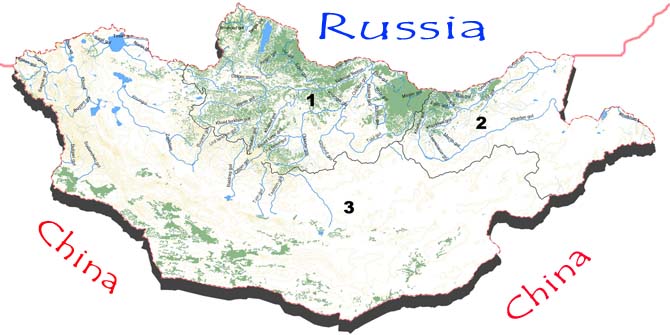
- Has three main hydrological basins: 1) Arctic, the 2) Pacific and 3) Central Asian closed basins
- Relatively poor water reserve: Water amount much lower per unit area of land compared to the world average. Water resource distribution and per capita availability varies among geographic regions: with 4500 m3 for the Gobi and 46,000 m3 for the central and northern regions.
- International Significance: Serves as the Central Asian Flyway & refuge for migratory waterfowl and home to numerous trans-boundary water bodies.
- Socio-economic and ecological value: Life-supporting service to people; wildlife and natural environment.
Protection Status: 15% of the area taken under special protection comprises of freshwater habitats of :
o 1 World Heritage Site (Uvs Nuur Basin)
o 11 Ramsar Sites
o 2 more sites registered with East Asian Anatidae Sites Network (Terkhiin Tsagaan Nuur, Ogii Nuur); and
o 1 area designated as the Man-Biosphere zone
Mongolia’s saltwater and freshwater lakes, which are great for camping, bird-watching, hiking, swimming, fishing and boating.
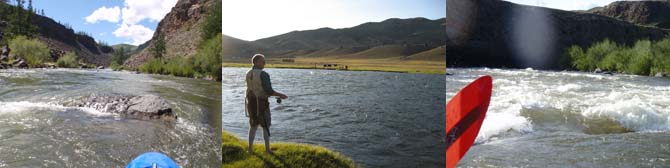
The rivers, which are great for rafting, kayaking, canoeing, fly-fishing and bird watching.
The river network is more developed in the north than in the south. From November to April, the rivers and lakes are frozen.
Our Partners


Get Social
 Facebook
 Twitter
 YouTube
 Blogger
 Flickr
 Abc of mountaineering


